
Today was my first full day of riding in Tierra Del Fuego, the Southern-most island of Patagonia. The landscape down here is just spectacular: Mountains, Ocean, lakes, forest, rivers, valleys … The weather during the day was a bit of a rollercoaster, starting rather unfriendly with rain and cold, but with a brilliant ending!

First I was doing some email and Blogging in the morning; since I had only 106 km planned and there are 17+ hrs of daylight I figured I wasn’t in a hurry. It was noon when I left Ushuaia with just a small snack and some fruit juice and water for along the way.

Right after Ushuaia the road turns inland and starts climbing up into a side valley. It started to rain and was rather chilly. While going uphill I stayed warm enough for my short-sleeved shirt and I didn’t bother with the rain gear yet. Here I was getting more and more wet and cold after just 10 km and briefly thought about the 10.000 km ahead of me in South America. But nothing is as constant as change, and that’s especially true for the weather in Patagonia. When I reached the Valle Hermosa after the first 300m hills a few patches of blue sky became visible.

Then I had another period of rain and the climb up to the 400m high Paso Garibaldi; this was hard work again. That said, I was happy to ride uphill due to the generated body heat and also because I knew that beyond the pass it would get easier and probably even more scenic.

At the pass I met French rider Isabelle – she had come all the way down from Ecuador and was on her last day to Ushuaia! We exchanged high fives and took pictures, but it was too cold with the wind to linger. On the way down I put on my new GoreTex wind jacket which saved me from hypothermia. I had this weird fantasy of coffee and cake, but suppressed these thoughts quickly as I deemed it impossible to get such luxuries here in the middle of the wilderness. But sure enough, to my pleasant surprise, I came upon a new restaurant which was open and served delicious cakes with coffee!

In addition, they had a wood-fired stove going which was very comfortable to sit next to (and helped me dry up my bike jersey in the process). So much for a lucky break!
And it was getting better: Now the wind was blowing nicely from the back and the sun was coming out. Going from rainy uphill to sunny downhill with tailwind – you have to experience this to understand how happy this makes the touring biker…

The scenery became more and more stunning now with the sun painting beautiful colors. And then I reached the Lago Fagano. The road follows its shores for about 35 km all the way to the Eastern end in Tolhuin (my goal for the day). I needed to stop a few times to take in the scenery and take pictures. What a great outcome of a day that started with rain!

January 14th, 2010

Yesterday I reached Ushuaia after flights from Miami via Buenos Aires to Santiago (including a close fly-by near Aconcagua in excellent visibility) and then via Punta Arenas to Ushuaia. My mountain backpack stayed behind in the hotel in Santiago; I’ll ride back up there over the next 6 weeks or so and then switch my bike and mountain gear for the Aconcagua expedition.

The last two hours of our flight were all covered in rain clouds; the 10-day weather forecast is not good – lots of rain and pretty cold (50F, 10C), and I have read horror stories about the stormy wind in Patagonia! That said, during the last minutes of our flight the sky cleared a little bit and the sun came out – what a welcome to this Southern-most city!
Then I needed to re-assemble the bike. I’m getting more used to this now than I would like… And I fiddled 1/2 hour to get the trailer wheel back into the trailer frame – apparently the latter must have been bent during transport, slightly annoying. But eventually everything was put together, and I put my empty bike box next to another one with a Swiss name and address on it (so I’m not the only rider).

It was already 7pm when I started to ride. It felt really good to pedal again – somewhat cool (52F, 11C), but not uncomfortable. The surroundings reminded me of Iceland, with snow up in the mountains above the fjord-like bays. I tried getting some cash as I didn’t have Argentinian pesos, but the ATM machine failed to dispense any money!? So I bought a big orange juice and some bread with my last small dollars and set out to ride down to Bahia Lapataia, the Southern end of the highway.

Even though it was now already past 8pm, I was not too concerned, as the sun sets at 10:05pm and it is still light until almost 11pm. It’s not quite as extreme at 55 degrees South as it was up in Alsaka (70 degrees North) last July, but still very different from the tropics in Central America.
My first surprise was the traffic, lots of cars driving back from Bahia Lapataia – and kicking up lots of dust on the gravel road. It’s high season down here. While I was the only rider, there is no solitude down here, even at the late hour. Also several camp grounds and tents along the way, so not exactly the untouched wilderness, but still great.
I got to the endpoint around 8:45pm and stayed for 15 minutes or so. The obligatory photo was taken as the last tour bus left the parking area. Some quiet time allowe to reflect: This is the Southern endpoint of the Panamerican Highway. Only 90 miles to Cape Horn, and just 1100 km to Antarctica. I walked out to the actual beach.

I recognized this spot from photos on Stefan and Pius website (panamerica.ch) My recumbent had already been here two years ago (Stefan riding it) – quite amazing. This may be the first recumbent to do the Panamerican Highway twice, who knows?
Then I returned back to Ushuaia. It started to rain a little bit, but not enough to warrant getting out raingear; I was riding in shots, which on the uphills was comfortable, but downhill it was getting quite chilly. Due to the cloud cover and sun down it was now getting more and more dark, with the city lights of Ushuaia visible in the distance.

Now the journey heading North can begin!
January 14th, 2010
Later today (Jan-11) I will board a plane to Santiago de Chile and then on to Ushuaia, Chile. In a few days I will start riding from the Southern-most point in Patagonia back up North towards Central America. While I rode North to South in the first part (North-America from the top down), I will now ride South to North (South-America from the bottom-up). This way I can again take advantage of the (Southern) summer with relatively warm temperatures and long daylight hours.

In the last two weeks I have spent some time getting ready for this next part of my journey. Among other things, the bicycle needed some maintenance (new chain, new tire, new bearings, cleaning and lubricating). Hence I needed to assemble it out of the (Panama) box and at the end disassemble it again into the (Patagonia) box. This X-Ray screen shows how the bike fits upside down with the two wheels under the seat (and the small wheel from the Bob Yak bike trailer for convenience). Only the front portion of the frame is sticking out a bit, but it’s actually like a handle to move the box and it’s a pain to take the central frame bolt apart…

Then I have the two bike panniers with bike clothing and some tools as well as the bike trailer with camping gear. I also needed to pack my mountaineering backpack for the upcoming expeditions on Aconcagua (end of February) and Ojos de Salado (early March). My total luggage weight came to about 90 kg (200 lb) with three checked and two carry-on bags. With Aerolineas Argentinas I only paid $72 extra for the bike.

Some of the mountaineering gear had still been in the box I had sent back from Puebla in Mexico after Pico Orizaba in Oct-09 and earlier from Anchorage in Alaska after Denali in Jun-09. The mountain gear has travelled back & forth quite a bit…

The last 2 weeks have been a time of reconnecting with family and recharging my energy – both physically and mentally. I have regained the 12 pounds or so I was below my normal weight – a nice “task” during the Christmas time (special thanks to all relatives who baked cookies and cakes)! I also had time to reflect on the previous part of my journey and mentally prepare for the adventures to come. Now I look forward to riding and climbing in South America!
January 11th, 2010

One week ago I temporarily returned from riding and hiking in the tropics of Central America back to the normal everyday life at home (Florida). A great time to enjoy reconnecting with family, relaxing without day-long rides or hikes, replenishing energy and motivational reservoirs.
I also came back to the life of news, mainstream media and their end of decade reviews. I always liked the year-end reviews in the newspaper, as they are a bit more thoughtful and cover a greater time-span than the regular, short-term and superficial news-bites. And I particularly enjoyed this time around with the end-of-decade reviews.
The overall tone of this decade’s assessment is fairly negative; looking at the economy and financial world, Economics Nobel prize laureate and NYT Op-Ed Columnist Paul Krugman calls it the Decade of Zero, where we (Americans) have achieved nothing and – worse – learned nothing. Other writers call it the “Decade of Suck“. In the Palm Beach Post cover story “Ten Years that changed America” author Scott Eyman makes a few interesting observations:
“On the social and technological front, the increasing use of wireless networks intensified the clamorous yawp of the Internet. Audiences and media shattered into ever smaller shards. Movies played on iPhones, texts became tweets, people compulsively updated their banal daily activities on Facebook or the monkey chatter of Twitter. The obsessive nature of so much of the Internet culture, not to mention the accusatory shrillness bred by anonymity, led author Thomas Mallon to observe, “We’ve gone from how the unexamined life isn’t worth living to how the undocumented life isn’t worth living”.”
Some of his other comments also reflect what I feel has become a short-term, voyeuristic, living by proxy culture: “At the end of the decade, the culture was in an ever-increasing cycle of diversional sensation – David Carradine’s kinky death was replaced by Michael Jackson’s drug overdose, which was replaced by a succession of American dreamers of varying degrees of derangement in perpetual competition for their own reality show: Octomom, Jon & Kate, and Balloon Boy, who had their time in the sun waiting for Tiger Woods’ round robin of revolving mistresses to make people forget about David Letterman’s more limited indulgences.”
The interesting question here is: Why do we (on average) care so much? What is it that makes us consume so much trivial chatter? Is it the instant gratification of not needing to wait, act or think much for the short-term high of a news sensation? Of not having to get out there (how inconvenient) to get our own experiences?
I also read a few adventure review stories, including the review by Tarquin Cooper in the British Telegraph on A Decade of Adventure, the Top Ten adventure trends of the decade in AdventureTravel or the Top Ten Adventure Stories of the Decade in the Outside magazine. Plenty of big and familiar stories in there, including lots of cycling and hiking. Indeed, fellow adventurer Mark Beaumont, who had made the first list above, is doing a very similar project to mine called Cycling the Americas.
Some of this made me reflect on my own reporting about my project:
Is my unrecorded life worth living?
Who cares about my monkey chatter on Twitter?
Is my trip any different whether I have 50 followers or 50.000?
Do I have to be a first or break a record to count for anything?
I didn’t primarily set out to examine my life, although I don’t think I’m just recording it either. Looking at those images from traversed countries and climbed mountains brings back vivid memories, which will remain with me for the rest of my life and are somewhat accessible to all who care about them. There may be ever smaller shards of audiences, but to those few (and myself) the journey matters. In fact, inspiring people who I otherwise wouldn’t even have met was one of the most rewarding sensations I have had so far on this trip.
And I conclude that neither you or I have to be the first or fastest or fittest in order to have an extraordinary experience. People often ask me how I prepared or seem to imply that one needs to be superfit for such an adventure. You just need to be fit enough and – more importantly – committed enough to begin it. Most adventures fail not because people aren’t fit enough, but because they were never started in the first place. Something to ponder for all of us for the next decade!
December 31st, 2009


The last country on the first part of my journey is Panama. I crossed the border on December 18 and rode to the town of David. There I found a hotel near the bus terminal, arranged for my bike to be stored there for one night, changed into hiking cloths and hopped on a bus North to the little town of Boquete. This village in alpine setting around 1000m ASL is a nice contrast to the hot and humid climate near the Coast. Up here it reminds me of some of the mountain villages in Austria, with a river flowing through town and fresh cool air at night. I found a hostel next to the river with Internet, so I could update my SPOT page and check email. For the next morning I would get a cab and drive up to the National Park entrance.

Volcan Baru has an altitude of 3474m, which makes it the high point of Panama. From the NP entrance there is an elevation gain of about 1700m, plus a little bit of up-&-down along the way. In many descriptions it is recommended to hike up one day, camp near the top, get to the summit the next day at sunrise and then hike down. Alternatively, some guides offer to ascend at night to see the sunrise from the summit. The allure is to see both the Pacific and Atlantic at the same time when it’s clear in the morning. However, there was rain last night and it was generally cloudy, so I didn’t feel that sunrise would be visible or even without clouds. Secondly, I didn’t want to ascend the entire way in the dark. So I started the hike just around the first daylight.

The paths climbs mostly through cloud forest, with the occasional nice meadow. This is a 4-wheel drive track, pretty rough, but I did see both two ATVs and later two regular jeeps making their way up there. The reason for this road: There are about a dozen radio antennas near the top.
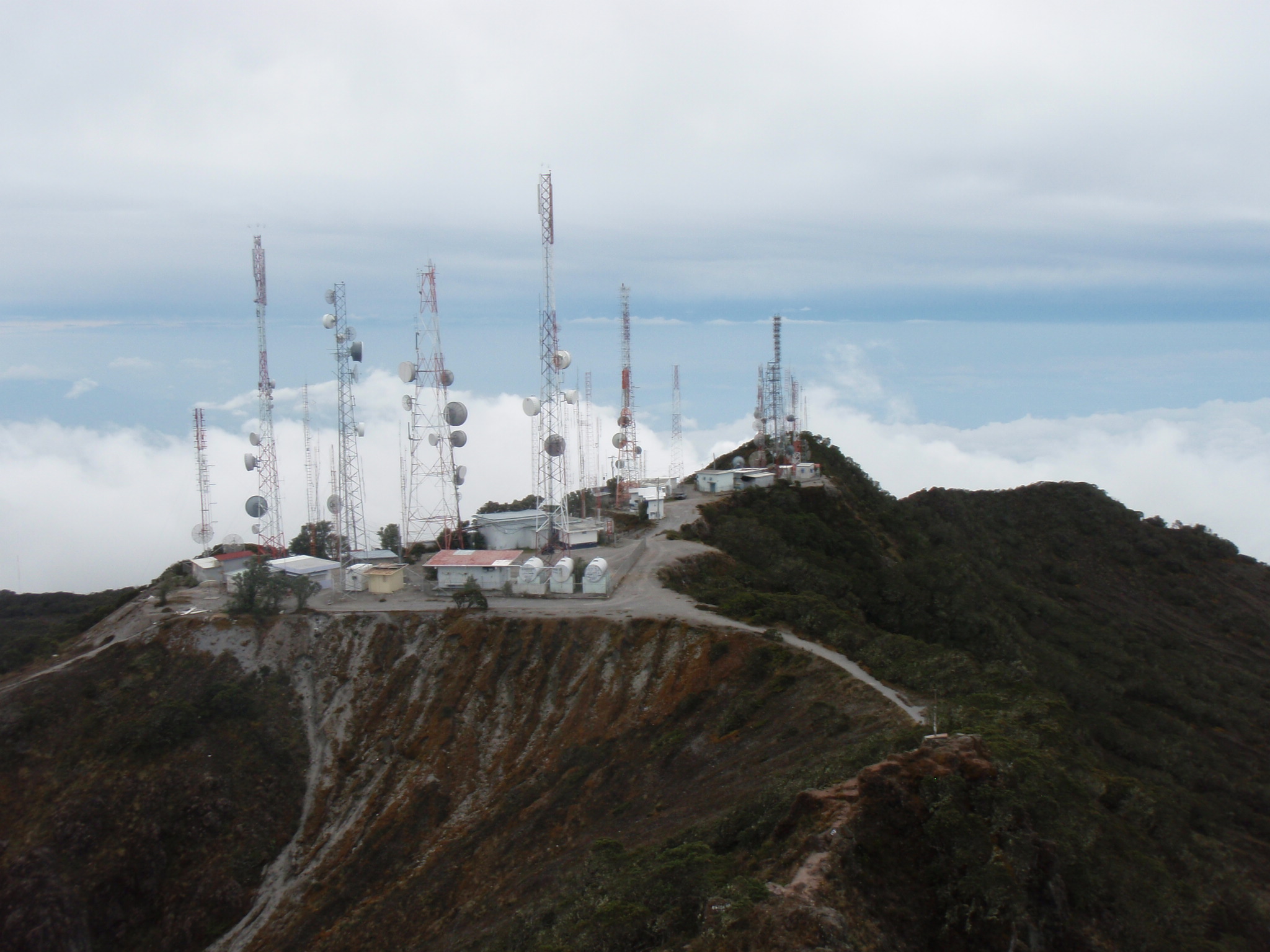
From those it is only another 10 minutes to the top of Baru. I could see the Pacific Ocean, but the Atlantic was completely covered in clouds.

Giong up took me 4.5 hrs, I stayed at the top for 0.5 hrs, and made a quick descent of 2.75 hrs. Round-trip time was 7 hr 45 min. It was a long hike (28 km round-trip, 1900m elevation gain), but I stayed dry all the way and was happy to have completed Panamerican Peak Number 10!

I went back by bus from Boquete to David and stayed there one night in the hotel. The next morning it was back to the hot and humid weather on the road. It was December 20th and I needed to be in Panama City (450 km) on the 23rd. No time for rest days, unfortunately. Instead I decided to go about 130 km each of the first three days.

Stefan Dudli (who owned my bike before and rode here on it 2 years ago) described this section on his website (www.panamerica.ch) as “HHH”: Hills, Heat, Hunger. My main problem now was the extreme heat. Often it got up to 37C (100F) and climbing the hills in stale, humid air was just extremely tiring. Throw in some Diesel exhaust of passing buses and then run short on daylight at the end of the day – this made this section very trying.

One day I ran out of daylight at a hilltop and looked for some place to stay. As there was no hotel I asked at the local police station and sure enough I could camp on their grounds.

Two days later I had a similar problem when the only hotel in town (Capira) had been closed and abandoned a few years ago. I asked the local firefighters and they let me camp on their grounds.

The last day had a much shorter ride, as I needed to get to near the airport with at least a half day to pack my bike. The 55 km from Capira to Panama City were relatively easy, but for the very poor quality road (50 year old cement road with lots of cracks and bad shoulder).

The last couple of km leading up to the bridge over the Panama Canal, the Puente de las Americas, were especially busy and narrow, some of the most dangerous riding on the entire trip. But the scenery over the bridge was a real highlight, and a geographic endpoint to this part of my journey. When I rolled down the other side of the bridge, emotions welled up and some tears of joy and relief rolled down my cheeks.
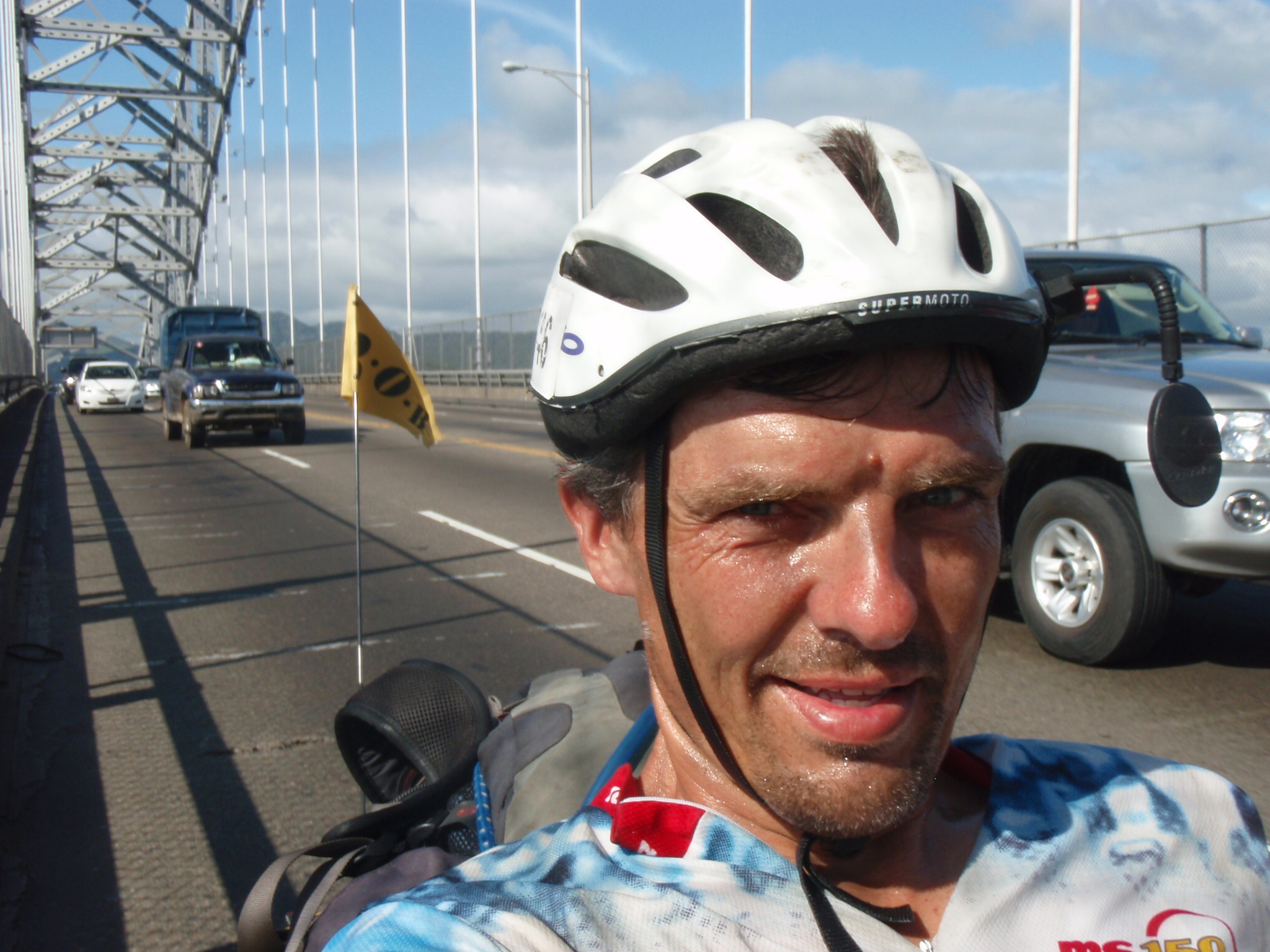
No time to slow down yet, though. I still needed to cross Panama City and get to the airport. They say Panama City is like Miami, except you hear more English spoken there 😉 It’s true, the skyline right along the water is very similar to Miami, and there is a lot of construction going on.

The rest of the day was pretty hectic: I looked for some breakfast with WiFi, but didn’t find WiFi despite checking in 5 places! So I continued to ride towards Tocumen about 20 km East of Panama City to get to the International Airport. There I checked into the main hotel, even though it’s prices are American. (I paid more for this last night than for all my stays in the last week or two.) But I needed a spacious room and I hadn’t had a shower in two days… Then I did my laundry and went to a nearby bike shop to get a box to pack my bike into. Cleaning and disassembling the bike took 3 hrs, almost as much time as the ride today. I also needed to pack my trailer and two panniers, plus dry out the tent and just generally sort my stuff. In between I had dinner and sent email as well as wrote this Blog post.
After nearly 6 months, 13.765km and 745 hrs of riding I had covered the entire distance from the Arctic Ocean to the Panama Canal. Except for the bus ride through Mexico City I rode my bike the entire way. And I hiked the 10 high-points of Alaska, Canada, U.S., Mexico, Guatemala, El Salvador, Honduras, Nicaragua, Costa Rica, and Panama. Except for not reaching the summit on Denali, the Panamerican Peaks adventure went very well according to plan so far. I am very pleased with Part 1. Now for a 2 week break at home for Christmas and New Year, then on to South America for Part 2.
December 23rd, 2009
Next Posts
Previous Posts