After several weeks of procuring and fine-tuning the new recumbent bike I finally picked it up from the dealership last Friday. A few parts had to be replaced, including the front disc brake, but now the bike is in pretty good shape.
Today I went for my first real test-ride up North along Jupiter Island to Hobe Sound. Here is a little video-clip after my first hour on the recumbent:
As expected, the position is comfortable, but different from what I’m used to; different muscles are used and so it will take some time to fully get used to the supine seating position. Also for first-time recumbent riders like me it takes time to get used to the rather iffy and nervous handling of the bike, especially when riding with only one hand. Also, slow riding and tight turns require much more attention than on a regular bike – I hope I will still get more used to this.
There are still a few things I will need to tune to get an optimal experience:
The gear transmission ratio is too low. At 32km/h (20mph) I’m already using the highest gear, and I can’t spin it faster than about 38km/h. I will have to install a larger chain ring in the front (the old one was worn down a bit already and with a new chain it’s a good time to swap it out anyway.
The pedals are still not far enough out so I can’t fully stretch my legs yet. I will need to extend the chain a little more to accommodate that.
The bike computer’s position on my right handle bar is only temporary. I can hardly read or operate it; besides it is in jeopardy in case the bike falls on it’s right side. It will probably be best mounted on top of the main frame tube between the legs.
There will likely be a couple of other things, but I consider this a promising start.
I’m also testing some other equipment today, as I’m uploading photos and videos as well as writing this Blog post on my Dell Mini 9 Netbook from Hobe Sound, courtesy to the free wireless Internet of its library which I found using the WiFi Finder on my iPhone … (The library is actually closed on Mondays, but the wireless still works 🙂
Now back on the road for some more training and test miles!
Electronic equipment can provide safety and more fun on the road or mountain. Here is a sample of the components I plan to bring along:
Some of my electronics equipment
Dell Mini 9 Netbook Computer: Light-weight (2.2 pounds) mini computer with 16GB solid state disk, Win XP, wireless Internet, Bluetooth, integrated webcam, USB ports, running 4 hours on a battery charge.
Olympus Stylus 790 SW Digital Camera: Shock-proof and water-proof 7 megapixel camera, with 2GB xD storage card for thousands of pictures and hours of video.
Solio hybrid Solar Charger: Universal charger for electronic devices; charges from sun or socket – anywhere in the world.
Apple iPod / iPhone: Portable phone, camera, GPS, music and audiobook player, app and game platform, with wireless Internet and AT&T 3G cellular network.
A secondary mission of this project is to document the trip and eventually write a book about it. In order to provide frequent updates from the road / mountain, I plan to bring this equipment along on the trip. In fact, the above photo was taken with the iPhone, and the Blog post was written on the Mini Netbook. (See also the related NYTimes article from yesterday on “Light and Cheap Netbooks are poised to reshape the PC industry“.) The plan is to write trip reports and organize photos on the Netbook, and to upload them to my Blog whenever I get to a place with wireless Internet. That will also allow me to check email and to stay in touch with my family and friends using email and Skype video-chat (should save on the phone bill :-).
Additional things I’m considering:
Small helmet camera for action video shots
SPOT GPS tracking device for emergency locator service and passive tracking
Satellite Phone (brought to Logan and Denali by expedition outfitters for safety reasons)
Bike movement sensor / alarm (to prevent silent bike theft)
USB sticks to copy photos off camera and distribute storage (reduce theft and damage risk)
Sigma Bicycle Computer
Kindle eBook Reader
Got suggestions for additional gear? I’d love to get your comments or suggestions on this topic.
Living in Florida there is no way to properly test winter camping equipment. Hence I had booked a 4 day weekend trip to the Grand Targhee skiing region in Idaho near the famous Wyoming ski resort of Jackson. The trip starts out testing patience more than anything, as my last leg from Denver to Idaho Falls was cancelled due to a blizzard in Denver! So I get stuck at the Denver airport for almost 24 hours. Time to sleep and to work on that Panamerican Peaks fund-raising email campaign – courtesy to the free wireless Internet at the Denver airport.
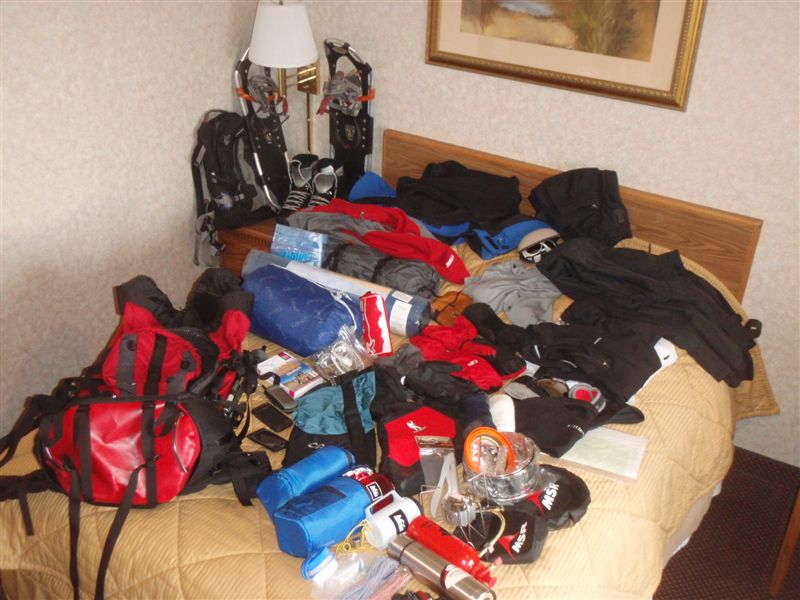
Finally I make it to Idaho Falls on Friday and check out the local ski rental shops. meet some very friendly locals in the ski shops, among them Big Mike (who had been on Denali) and Lars (who had been on Mt. Logan). They give me some good tips for winter camping and also for a good area for my gear shakedown trip. In the hotel I spread out all gear prior to packing it into my Gregory Denali Pro backpack:
Next day I drive up to the Pine Creek Pass (6764ft) and park the rental car. From here I start with snowshoes as nobody around here has the Silvretta Alpine Touring binding I would need for my Scarpa mountaineering boot. (Good to know that ahead of going to Logan.) The 50 pound backback weighs heavy, but otherwise conditions are good as I set out around 2pm.
I hike along a ridge up & down the ridgeline with views down to the Driggs valley. After 2 hours I reach a nice saddle between two high-points and descend into an untouched winter forest. This will be a good spot for the campsite, as there is a severe weather alert for a winter storm moving in with 30mph winds…
I also get out my MSR Dragonfly expedition stove and start to cook some tea and hot soup.
Now I still have some time to explore the ridge line and the nearby surroundings. Without the backpack I feel like I’m flying up the hill. I also take a few pics with my iPhone and from the ridge I have a signal so I can send them to my wife just for fun. Coming back to the tent prior to darkness there is snowfall which makes it eerily quiet in the forest.
After a reasonably good night sleep I prepare to hike out in what has become quite stormy conditions. In the forest there is a foot of fresh powder; crawling uphill with the heavy pack is hard work and you sweat quickly. Then you step out on the ridge and the 30mph wind hits you with blinding snowdrift.
Normally I don’t cherish such conditions, but in this case it is actually a benefit, as the most extreme Idaho weather at 7000ft is still only a warm-up compared to Logan and Denali conditions at 19.000ft.
Back at the parking lot I need to clear the fresh snow off the car and shuffle some snow to get out. But I’m happy about the gear test. Most of my gear is now functional, including my new mountaineering boots, with only minor adjustments around the camping, cooking and some clothing.
The single-most important decision for the Panamerican Peaks project is the choice of the bike. I estimate I will spend about 8 months on / with this bike, so the decision about the bike is important. After some research I have decided to take a leap of faith and go with a recumbent!
A few weeks ago I visited a local recumbent bike shop and did a test-ride on a few different recumbents. One of those was a trike, actually very intriguing, ultra-comfortable and stable; the Catrike felt like a combination of couch and race-car:
However, a trike has some disadvantages: You sit very low, which means you get overlooked easily and can’t see over parked cars in city traffic for instance. You take up more space on the road, which can be a problem if riding on a road without shoulder. You also don’t have much of a shock absorber, which can be very hard when riding on bumpy roads – which I can expect in Alaska and in many places throughout South America.
I finally set three criteria:
2 wheel recumbent (no trike)
Under-Seat Steering (more comfortable)
Same-size front + back wheel, preferably 26″ (spare parts)
One model which fulfilled all criteria was the Challenge Seiran, manufactured by the Dutch Challenge factory. This is the model which Stefan and Pius had used on their Panamerican ride. As it turned out, I ended up buying Stefan’s bike – likely this will become the first recumbent to ride the Panamericana twice! I flew to Europe to see family and friends, and also to pick up the Seiran directly from Stefan in Zuirch:
After disassembling it for transport in the airplane it is currently being assembled and over-hauled. I can’t wait to put some training miles on this bike in April!
I just submitted my Panamerican Peaks project to the “name your dream assignment” photo journey contest sponsored by Lenovo and Microsoft on National Geographic Adventure.
You can vote for my project by giving me a “Pic” vote here or clicking the logo below!