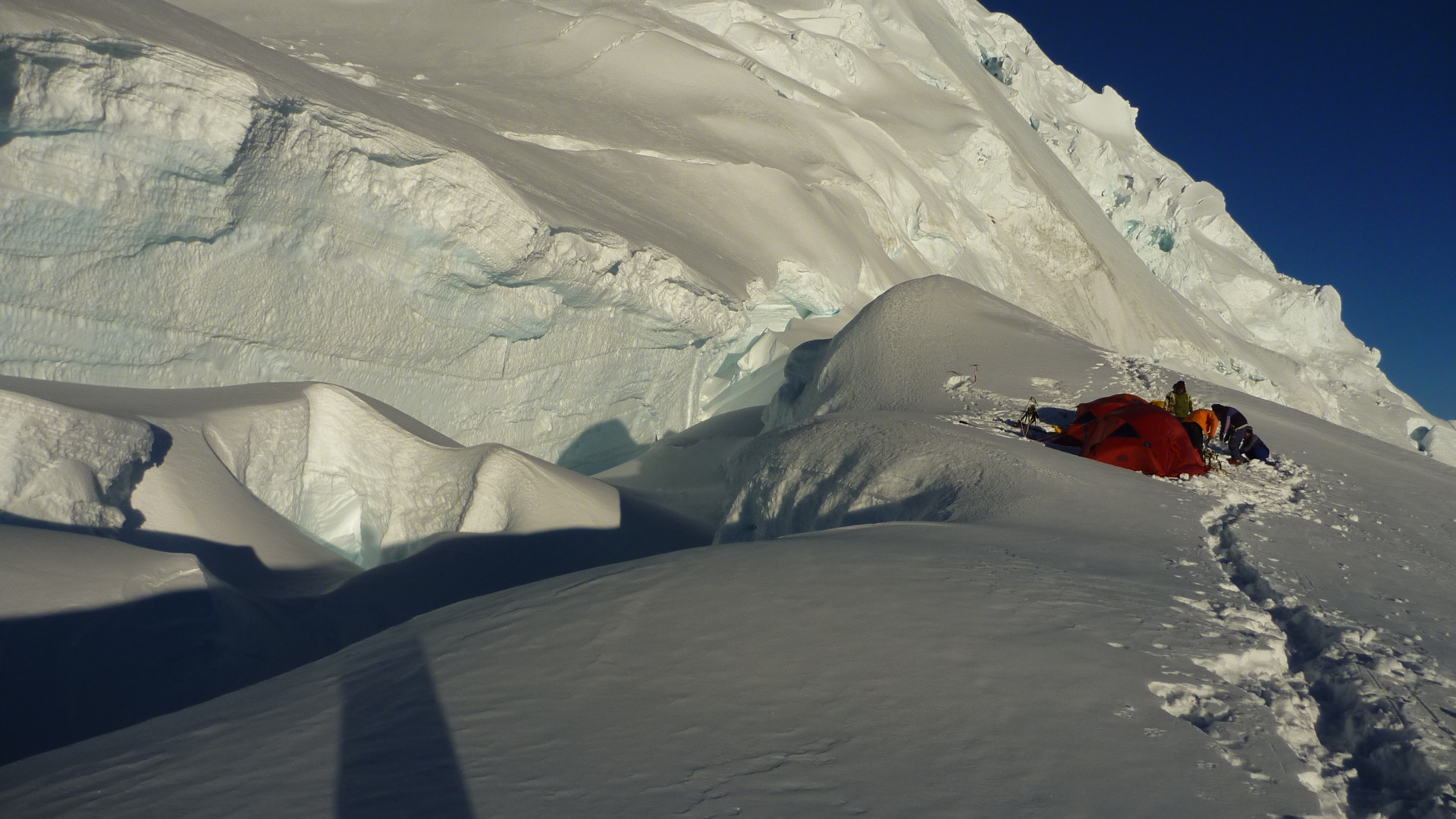
High above King Col near 5000m on Mount Logan, with King Peak behind and the Kluance Icefields in the background
It’s been two weeks since I returned home from my grand journey. Time to reconnect with family in Florida, time to unpack everything and time to settle in. Also time to adjust to a more normal life back home and to think back on the past year of adventure. Many friends have expressed to me that this must be a big transition for me – and yes indeed, it is. There are many deep questions: To what extent did the trip impact me, and in which way, shape or form? What did I learn from this trip? How does it change my future life? What now? – Here are some of my emotions during this transition and thoughts on these questions.
Emotions
My very first emotion is that I’m very glad I decided to go on this trip in the first place. I know it sounds like cliché, but it really was the adventure of a lifetime! I remember there were many skeptical voices and at least at one point in the spring of 2009 I felt like almost everyone was advising against the trip – I listened to my heart, trusted my own judgment and gave myself permission to go. I also feel proud to have completed the entire journey, to have reached 12 (of 15) summits, some of them way bigger than anything I’d done before. I am happy that I returned home in good health and without any accidents or crippling equipment failures. People have asked me what is the most important quality to have in order to successfully undertake such a trip. I would say you have to have the determination to start, the perseverance to finish, and a bit of luck to come back unharmed.
I am extremely content and thankful to see that my family and friends are still here for me (as they were throughout the entire journey), almost as if I’d never left. I am also proud to have raised considerable funds for Doctors Without Borders – albeit very unevenly distributed and a bit less than I expected.
Surprises
When I think back, I ask myself whether the trip went off as I expected or whether there were any surprises. In most aspects, it did unfold more or less as I expected. The bike proved to have been a good choice and held up well. I enjoyed the comfort of its ride and I did muster the perseverance to see it through to the end. The mountains turned out to be hard and rewarding, and I was denied just a few (20%) of the summits. (I didn’t expect a 100% success rate, albeit for different reasons.) Technology served me well to communicate with my loved ones and to document the journey. I expected people to be friendly and curious, although sometimes the positive attention I got bordered on overwhelming! I only got sick once during the entire trip (in Bolivia, likely due to contaminated salad at a road-side restaurant) which on balance I think is about as good as you can hope for.
I did not expect South-America to be as tough as it was: First there was the extreme wind in Patagonia, which often scared me, slowed and at least once completely shut me down. Then there were the bad roads and incessant rain of the “Carreterra Austral” in South-Chile. While I had been very lucky with the dry, warm Northern summer 2009 in Alaska and Canada, the following Southern summer was very wet in South Chile. Sometimes I wonder whether I mentally could do the whole trip again (not that I’m planning that, certainly not); now with the knowledge of all that’s ahead I wonder whether I could set out again in Prudhoe Bay and persevere all the way across the Panamerican Peaks down to Ushuaia. I feel I was so excited and unburdened at the beginning, almost with a certain naiveté towards what’s ahead, it helped me break the project down into smaller, more manageable chunks. The recipe: Just take it one day at a time. And enjoy yourself while doing it. I also often found myself in the somewhat paradoxical situation that the less I worried about the little daily challenges along the way, the easier it was to overcome them. (For example where to find food or a place to stay for the night.) It always works out somehow, and pure confidence in this simple fact seems to alleviate many issues.
I certainly did not expect my bike frame to crack, which set me back by a good 2 weeks – but also gave me the opportunity for a surprise visit at home for Valentine’s Day! Chile’s highest mountain (Ojos de Salado) also eluded me, the only defeat in the mountains when the weather was very good! (I thought Ojos would be relatively easy after our success on Aconcagua, but I ran out of air way below Ojos’ summit – just goes to show that high-altitude performance remains a bit of a mystery.)
Unlike North and Central-America, I took several bus rides in South-America to overcome bad roads, bad weather, bad luck with my bike and at the end lack of calendar time.
I enjoyed having to spend little money on food in Central and South America as well as being able to converse a bit better in Spanish in the second half of my trip. Somehow the end of the trip seemed to come too fast, almost overnight, despite the fact that I could clearly anticipate it for many weeks. Just goes to show that you can’t really prepare well for the emotional impact of such a transition, no matter how long you are anticipating it.
Thoughts
Some friend wrote in an email “Welcome back home after this life-changing adventure!” It gave me pause: Was it life-changing? Not really. It didn’t change who I am or what I believe in. I didn’t set out for it to be life-changing, rather more life-celebrating. And what a celebration it was! I had weighed the relative merits of “more time” vs. “more money” prior to this trip, and I clearly decided in favor of more time: During the last one year I had more time to explore new countries, ride more roads, climb more mountains and meet more people doing so than I otherwise would have had in an entire decade!
I think back to my prior analysis of the journey’s likely risks and mitigation (Environmental, Crime, Political, Medical, Traffic). For the most part, I believe I was right on (and I don’t just say this to justify my expectations after the fact). Other than a one-time attempted inner-city robbery (zipper opening of my little backpack in Mendoza, Argentina) I never encountered any dangerous or criminal situation. Other than my one-time bad stomach in Bolivia I never had to open my First-Aid kit for any pills or to tend to any wounds. Really the main threat came from traffic – no wonder over the course of 20,000 km and often in countries where safety standards and practices are often woefully inadequate. If you ask me for examples of when I felt unsafe on the road, I can tell you of one incident in California where I was riding uphill through a right turn with tall grass impeding visibility; a pickup truck came roaring up the road, hugging the inside right turn; the driver must have seen me at the last moment and just barely avoided hitting me while passing at 100 km/h. Or one evening when I rode in the Baja California around dusk on a road with lots of traffic, but without shoulder, and three times trucks approached from behind honking, but not slowing down – had I not seen them in my rear-view mirror and quickly performed emergency exits off the road into the deep grass I would probably not be here now. I once rolled down a hill in British Columbia, doing 65 km/h with an impatient truck driver right behind me, when the whole bike starting wobbling ominously! At the bottom of the hill, after the truck had passed, I rolled out and examined my then near-flat rear tire only to find a one-inch nail sticking in it producing a slow leaking puncture! I was lucky, as that could have ended badly… I saw many wrecks besides the road, some that happened very recently, others just rusty remains of a bad mishap long time ago. Seeing those wrecks down in the ditch made me wonder whether I could potentially get caught up in such an accident, but I trusted my sense that this would statistically be extremely unlikely.
In the mountains there were a few risks, in particular icefall (barely predictable) on Huascaran and lightning (unpredictable) during one thunderstorm on Aconcagua. Overall I think I took reasonable precautions and made conservative and risk-averse decisions. Perhaps more than in other areas, in the mountains my experience helped me with good judgment to stay out of harm’s way.
Rewards
I learned a lot about the 14 countries I visited, particularly those I had not seen before. I learned a lot about myself, my (often complex) motivations, my (often basic) desires, and that I can get along just fine with very few possessions and comforts. (“Happiness does not come from having much, but from being attached to little!” ~Cheng Yen) I was pleased to see my body hold up well to the rigors of so many miles and mountains. I felt I had more fully realized the potential of my legs and lungs, stretching their limits and enjoying the process. It was brilliant to consume huge quantities of food and drinks, while simultaneously only worrying about not losing too much weight! It was great to have so many opportunities to just pitch the tent, drift away to many hours of deep sleep, wake up refreshed, quickly pack up the few things and set off in the cool morning hours for yet another day of unburdened discovery and physical exercise.
One of the most rewarding aspects of the journey was to have met many interesting people (turned into new friends) and oh so many friendly and mostly hospitable strangers (most of which I’ll likely never see again). Many friends (new and old) have sent me emails of encouragement and expressed some form of inspiration through my journey. After innumerable friendly contacts, small gifts, invitations, and encouragement from so many people I can’t help but think that wherever you go there are good human beings, trusting, warm-hearted, genuinely excited to see such an adventure playing out and helping along in small ways. Seeing that broad smile on the faces of the truckers, the road-side workers, the sheepherders and farmers out on their fields, the school-children or business people at the bus stop, or the astounded officials at borders, airports or bus terminals – I can’t help but imagine that this journey touched and resonated with a universal sentiment for freedom, wanderlust and outdoor activity. I can’t help but thinking that some of the many kids who alerted their friends or family about the strange, funny-looking bike they had never seen before (“Mira, Mama, Mira la bici!”) would dream of maybe one day doing some similar such trip. I can’t help but think that some of the hundreds, if not thousands of car passengers hanging out their windows and taking cell-phone pictures of me while passing were reminded of their own big plans and dreams. If my demeanor during those encounters “out there”, my writings and my photos online inspire just a few of the thousands of all these people to take the initiative and live out their own big adventure, then I would see that as a great success. One close friend said he was now thinking bigger in his own adventures after having learned about my project. To inspire others is one of the most gratifying sensations I have had on this journey. So let me close in this spirit, by reminding you that you, too, can dream it, plan it, do it!
A particularly nice day riding along the Pacific Ocean in Southern California just North of Los Angeles
Over the last week in June Jill and I were exploring the Ecuadorian mountains. (See also my Cotopaxi and Chimborazo photo library.) After an initial sight-seeing day in Quito we undertook a first acclimatization hike on Pasochoa (4200m). It was a nice 6 hr hike starting at some private farms across grassy meadows up to an old volcanic crater. Unfortunately the mountain was mostly covered in clouds all day and the last two hours the drizzle turned to light rain. We were happy to get to the Hostel that evening and fired up a wooden stove to heat the cold rooms.
The next morning (Sunday, Jun-20) we drove to the Cotopaxi National Park and stayed at the Tambopaxi lodge (3700m). From here we did a second acclimatization hike on Ruminahui (4700m), an old volcano next to Cotopaxi. While we started considerably higher, this ended up to be a long, 8.5 hr hike with some rain and ending in the dark. Again we were very happy to get back to the lodge and enjoyed great dinner and a good night’s sleep.
Then we had a lovely rest day with some horseback riding and lots of food and sleep. We were hoping for the weather to improve, and at least we got to see the beautiful cone of Cotopaxi in all its splendor from the lodge.
On Tuesday, June 22 we drove up to the Refugio Ribas (4810m) at the base of the mountain. Some crampons and ice practice on a nearby glacier and then some food and early rest in the bunk beds. Not much sleep that evening – this is as high as Mont Blanc in the Alps! – and at midnight on Wednesday, June 23 we started our ascent on Cotopaxi. Conditions were passable initially, with a great view of the city of Quito illuminated at night far below. It was a long and tiring ascent through the dark hours until daybreak up the scree slope and then up the glacier.
Unfortunately the wind increased more and more until we could no longer walk into the wind; we literally had to crawl on all four to make any forward / upward progress. The ferocious winds blew ice crystals in our faces and it was impossible to talk to each other or the guide 3 m away. We had to shout at each other from close range. We had reached 5640m – as high as Mexico’s Pico Orizaba – with only 260m to go. But these conditions were crazy, it got fairly cold and the winds were likely even stronger up the remaining steep section; so we decided to turn around after all.
We were both very tired when reaching the Refugio after some 11 hours in the cold wind and crawled into our sleeping bags for some rest. Unfortunately Jill had suffered a pressure injury from her wrist watch, which had been missing the inside metal cover for the battery compartment and the resulting sharp edges had pressed against her skin under the jacket and mittens. This left a nasty burn wound on the skin of her left arm, which she would have to treat with antibiotics, anti-inflammatory and skin cream over the next 2 weeks!
We drove to Banos for two nights and a full day of rest at much lower altitude (~2000m). There we enjoyed a leisure visit of several nearby waterfalls and viewpoints. Overall this provided a very good way to relax after Cotopaxi.
Then on Friday (Jun-25) we drove up via Ambato to the Chimborazo National Park. It’s amazing how far the road leads up – we ended up driving up nearly 3000m to the end of the park road around 4850m. From there we hiked the remaining 150m to the Refugio Whymper (5000m). From here we wanted to climb Chimborazo the next morning.
The winds howled all night with even some snow being blown through some cracks in the roof into the refugio’s bunk beds! At 11pm we briefly got up but decided to wait a bit mroe due to the extreme wind. At 12:30am just after midnight Jose and I decided to go for it, despite the still strong winds. We were dressed with pretty much all our gear, and thus it was comfortably warm.
The ascent via “The Castle” leads up some steep rock bands, all covered in hard ice this night, so not a place to make a mistake. After about 3 hrs we reached the ridge and the glacier; the only other party out that night had turned around before us due to the high winds. But I stubbornly refused to turn around: I had the best acclimatization of my life, was wearing very warm clothing and good equipment, and just wanted this summit really bad to finalize my Panamerican Peaks project. We drudged up that featureless slope for a full 5 hrs! Nothing to mark progress except the altimeter on my wrist watch. I slowed down due to the high altitude, but after some 8 hrs we finally reached the (Ventemilla) summit at 6270m. The weather was atrocious, about the worst I had had on any of my Panamerican Peaks. Here is a little video clip from the summit:
We didn’t attempt reaching the slightly higher Whymper summit (6310m) due to the zero visibility and very poor weather. Everything was getting caked with an icy layer, so photos and videos were very poor. My ski-goggles iced up and I had trouble de-icing them enough to see anything for the descent. Also, the going near the top was very tough due to very uneven ice, no path and us breaking through the ice into hip-deep snow. Even the descent was very tiring in these conditions.
While it wasn’t the glorious finale to my project that I had envisioned (with unlimited visibility and little wind just like on Aconcagua) I was still content to have reached the summit of Chimborazo – the furthest point from the center of the Earth! It was my 12.th summit on 15 peaks, an 80% success rate in the mountains. I didn’t reach the summit on Denali, Ojos de Salado and Sajama, but had a respectable attempt and made it to within less than 1000m of the summit on all of them. My South-American summits – Aconcagua, Huascaran and Chimborazo – they all posed very special challenges and will probably remain the three highest mountains of my life!
After the 10 days of climbing in the Cordillera Blanca and 1 rest day in Huaraz I continued cycling North towards Ecuador. I followed the Rio Santa valley down from Huaraz to Yungay and beyond. This valley offers spectacular views to the peaks in the Cordillera Blanca, including Huascaran and Huandoy.
The road is paved, but has a lot of big holes in it; as a result most cars and buses are swerving wildly from side to side to avoid the worst of the potholes. I have lunch at a nice restaurant near Yungay; the restaurant displays both the daily menu as well as the world cup soccer matches of the day on two blackboards – it’s the first day of the 2010 soccer world cup!
I continue in the afternoon riding down the valley – assisted by the considerable downhill all day. After Caraz the valley narrows more and more into what eventually turns into the very narrow Canyon del Pato. Here the two sides of the mountains get to within just a few meters of one another, with the river having carved a steep and narrow passage. The road turns into a one-lane gravel path, with lots of tunnels and often steep drops to the side without any rails or fences. So the ride is a bit rough, but the scenery is stunning. Unfortunately there is hardly any more water in the river bed due to a hydroelectric power plant below. Nevertheless, the Canyon del Pato is an amazing place.
In the Canyon del Pato above Huallanca
I reach Huallanca, a small village in the Canyon and stay for the night. There are two hostels, a nice one and a pretty barren one. The nice one has all rooms fully booked, but I don’t want to stay at the other one. Turns out I can pitch my tent on the flat roof of the nice hostel after all! Unfortunately I forget my SPOT satellite tracker on this roof the next morning – something which will later cost me 2 days to recover the device!
The dusty and dangerous bus ride through the lower parts of the Canyon del Pato
The next day I continue by bus down towards Chimbote on the Coast, as I had been told that the road is pretty rough for the next 50km or so. They load my bike, panniers and trailer on the roof of the bus – I will later lose the rear reflector and a hitch pin as a result of that, though! The bus ride is fairly rough and dangerous, as the driver is going way too fast IMHO and there are many places along the road where the margin for error is small and any mistake could easily send the bus plunging into the depth of the canyon.
I get off the bus in Santa, some 15km North of Chimbote. Here I will spend 2 nights, essentially waiting an extra day for the SPOT device (being sent on the same Huaraz Express bus the next day). Then I ride North to Trujillo on the Panamericana. This stretch is a mix of Coastal desert, with tall sand dunes and very barren landscape, interspersed with some plantations near Chao and Viru, where there are some small streams of water from the mountains. Once I need to cross a 400m high dune – slow on the way up, but very fast (75km/h) on the way down.
A 400m saddle with sand dunes North of Santa
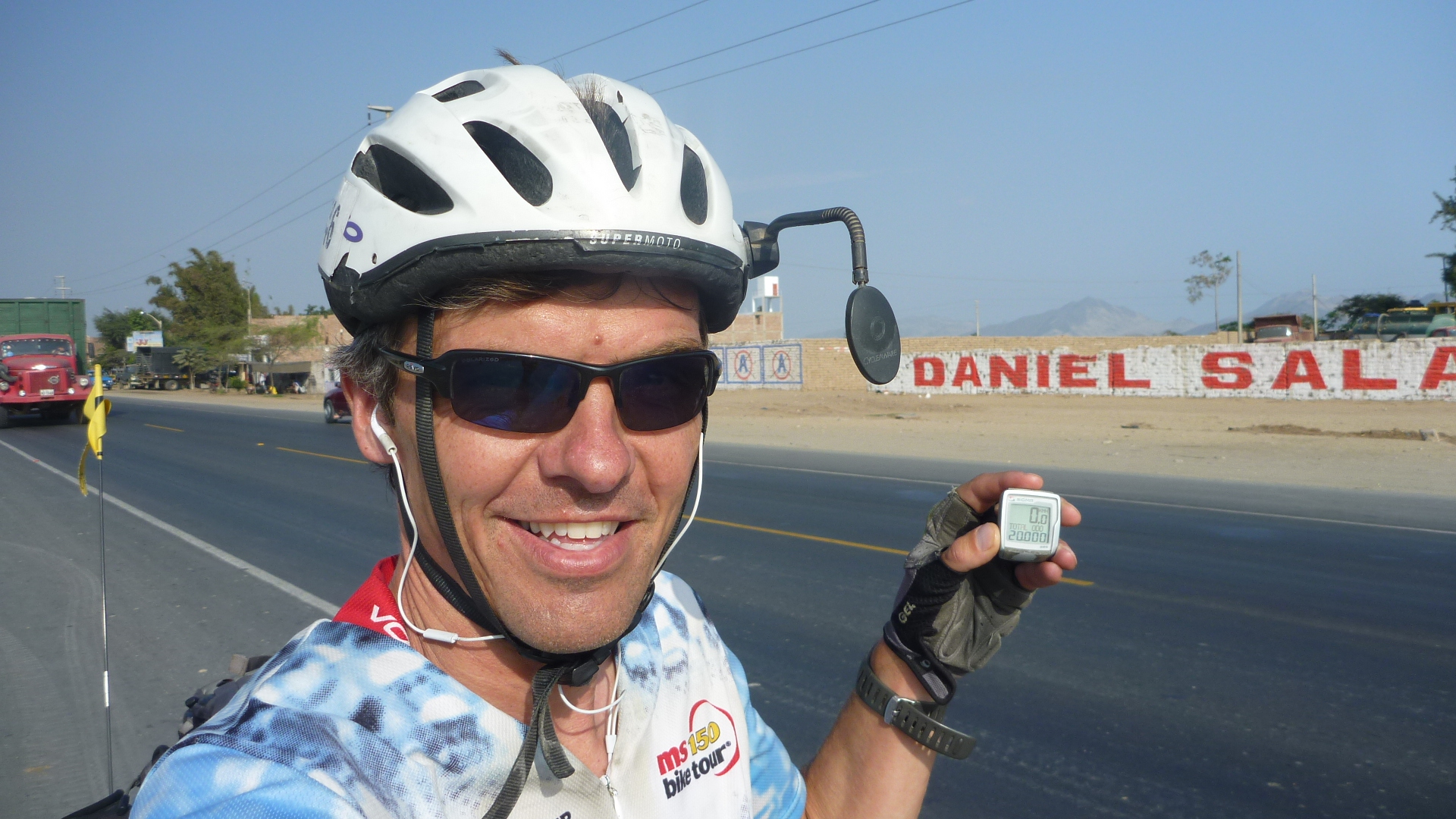
On this section I also reach the 20,000km mark – I still remember the 10,000km in Central Mexico, seems like an eternity ago…
Reaching the 20,000 km mark on route to Trujillo, Northern Peru
It’s a race against time as I left a bit late for this 125km day, with more than 1000m vertical climbing due to many hills. When I finally reach the crest of the last big hill and can see Trujillo down below me I am jubilant. I ride into town and plan to go to Lucho’s famous Casa de Ciclista. I don’t know his address, though. How do you find such a place in a city of more than 1 million inhabitants? I first ride towards the center, hoping to see a bike shop whose folks might know Lucho’s place. Then when it gets completely dark I stop at an Internet place to Google the place. Unfortunately, the previous URL (geocities) is no longer valid. Eventually I find a description with the address, so now I have something to aim for. I strap my lights on and ride through the dark city streets full of traffic – not very safe… I eventually get there, meet Lucho and a few other cyclists at his place. Unfortunately he has no running water this time of the day, so I ask for a nearby Hostel. He guides me – by bike – to a nearby Hostel where I stay the night.
The next day I explore the nearby beach town Huanchaco by bus and then prepare for my overnight bus ride to Guayaquil and on to Quito. I realize that the bike part of my journey is over now; there is just Chimborazo left to climb in Ecuador during the 2 week vacation with my wife!
After a 3-day acclimatization climb (unguided) on Nevado Pisco (5760m) I embarked on a 7-day guided expedition to Huascaran Sur: At 6768m this is the highest peak in Peru, the highest mountain in the tropics worldwide and the third highest of the Panamerican Peaks.
Huascaran seen from summit of Nevado Pisco - Sur next to my ice axe, Norte to the right
I had joined a twin expedition on Huascaran. We had two small groups, one consisting of two Spaniards and guide Darwin, the other group just me and guide Christian, plus two cooks and four porters. This team as well as drivers from/to Huaraz and mules for transport to base camp was all expertly arranged by Enrique Expeditions in Huaraz.
Huascaran as seen from near Yungay - main summit Sur on the right, Norte on the left
We reached the summit of Huascaran Sur on Day 5 after 2 days and 2 nights at the high camp at 5810m. As we were early in the climbing season and Huascaran hadn’t been climbed yet this season, our guides decided to explore the route – which changes every year due to ice fall and crevasses – and break trail to make it easier for us clients. This cost us an extra “waiting” day up high, but this strategy worked 100%.
Camp 2 just below the Col between Huascaran Norte and Sur
Conditions on summit day started out very good, but deteriorated up high due to strong and very cold winds as well as cloud cover on the summit after sunrise. Due to less than perfect rental equipment I struggled a lot with the cold, reinforced due to the wind and high altitude. The last hour up to the summit was one of the toughest mountain pitches of my entire project. It was the only one of my summits shrouded in clouds (!) and the one where I stayed the shortest time (less than 10min due to the cold).
Sunrise over Huascaran Norte with Cordillera Blanca peaks behind - note the three climbers in the other group below.
Huascaran is a difficult and dangerous mountain. I’d say it ranks third in overall difficulty after Mt. Logan (Canada) and Mt. McKinley (Alaska) – and that only due to the remoteness and size of those two – and it ranks first in overall danger and risk: Huascaran has nontrivial terrain (granite slabs with friction hiking) to get up to the glacier. It has a huge glacier (due to the massive precipitation here in the tropics) with crevasses as big or bigger than those even on Mt. Logan and Mt. McKinley. The glacier ascent has a objectively pretty dangerous part in the normal route between Camp 1 and 2: in the Canaleta you have to climb a distance of about 300m vertical with huge seracs hanging high up above and an avalanche cone with massive debris fields a constant reminder that if something breaks lose above, it’s going to come down your way. The same is true for parts of the following traverse to Camp 2 near the Col between North and South summits. The other two clients and I agreed that in the end it’s a bit like a lottery – you just hope your number isn’t up that day. And on summit day you have to not only climb almost 1000m vertical at high altitude, but it’s also far steeper after the Col than I expected. Especially on the descent you have to be very careful as the route often traverses diagonally above huge crevasses – a fall there would send you right down one of those monsters.
Descent in the dangerous Canaleta
I am glad that Huascaran is behind me. Of all the peaks in this project, this is the only one I would not consider repeating – once is sure enough for Huascaran! Now there is only one of the 15 peaks remaining: Chimborazo in Ecuador. I’ll tackle this last one later in June together with my wife Jill as the Grand Finale of my Panamerican Peaks Project.
After riding North from La Paz along Lake Titicaca for 7 days I reached Cusco. Riding along the altiplano from Puno, over the 4338m high Abra La Raya, and then descending into the river valley down towards Urcos (3100m) and back up to Cusco (3400m).
Once in Cusco I took a needed rest day and also needed to get my front brake pads replaced (they had been worn so thin to be practically unusable), which took an extra day. I also met again with the Belgian cyclists Ellen and Nicolas, who I had met both in South Chile (Coyhaique) and in Bolivia (La Paz). They celebrated the end of their 8-month cycling tour through South-East Asia and South America. Also made me think more of the end of my own project in June 2010, which is fast approaching.
As I’m running out of time to cycle the entire distance up to Quito in Ecuador I need to take a bus for some sections. Since it was raining in Cusco I decided to take a bus to Lima and on to Huaraz, where I arrived this morning. Lima was nice for a day – also the first time I’d been at sea-level after 4 weeks on the altiplano and no less than 3300m altitude. But I decided to go right to Huaraz (3100m) to stage the climb of Huascaran.
Tomorrow I will join another group for a 3-day acclimatization hike on Nevado Pisco (5750m) and then, after one rest and logistics day (Jun-3) we plan a 6-day expedition on Huascaran. I will blog on those two mountains after returning from Nevado Pisco. (Follow the SPOT on a new page for the Huascaran Climb.)